The vocabulary
The base unit is the bica, Lisbon's word for espresso. In Porto the same drink is a cimbalino, after the La Cimbali machines; everywhere else it is simply um café. The story that "bica" stands for "beba isto com açúcar" (drink this with sugar) is almost certainly folklore, but it is good advice, because Portuguese roasts are darker than Italian ones and a bica takes sugar well.
From there, everything is a modification of the bica: shorter, longer, with a drop of milk, with a lot of milk, in a glass, in a cup. The table below is the whole board.
| Drink | What it is | Serving | Price |
|---|---|---|---|
| Bica / café | Single espresso, 36 g | Small cup | €0.90 |
| Café curto (italiana) | Short espresso, 25 g | Small cup | €0.90 |
| Café cheio | Long espresso, filled cup, 55 g | Small cup | €0.90 |
| Café duplo | Double espresso | Medium cup | €1.60 |
| Pingado / garoto | Espresso with a splash of milk | Small cup | €1.00 |
| Meia de leite | Half espresso, half steamed milk | Medium cup, 180 ml | €1.80 |
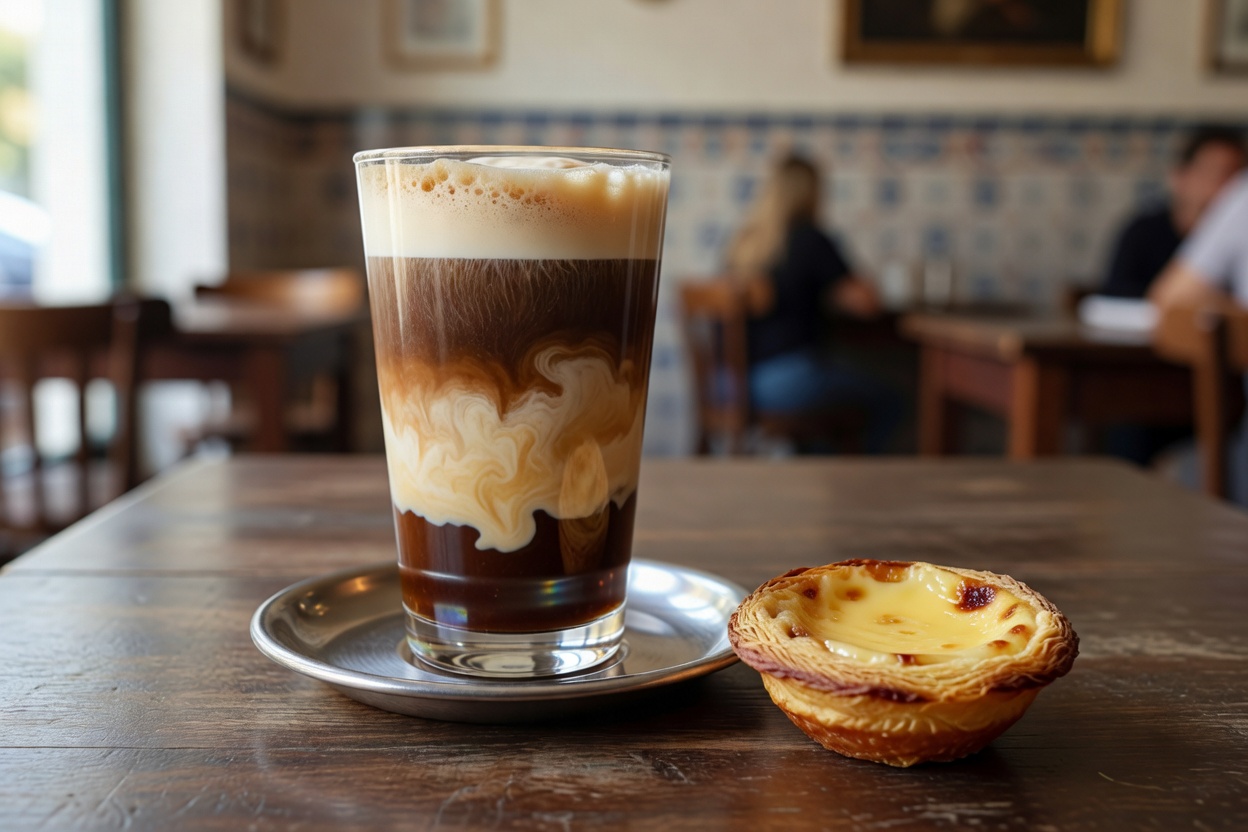
| Galão | One part espresso, three parts milk | Tall glass, 250 ml | €2.00 |
| Abatanado | Espresso lengthened with hot water | Medium cup | €1.40 |
| Carioca | Second pull of the same grounds, very weak | Small cup | €0.80 |
| Descafeinado | Any of the above, Swiss Water decaf | Same as base | +€0.10 |
| Oat milk | In any milk drink | — | +€0.40 |
The drinks that confuse people
Meia de leite versus galão. Both are milky coffees. The meia de leite is served in a cup, roughly half and half, and closer to a flat white or a small café au lait. The galão comes in a tall glass, is three-quarters milk, and is closer to a latte, though thinner because the milk is steamed hot rather than textured. Ask for a galão escuro (dark) for more coffee, or galão claro (light) for less.
Abatanado versus americano. Functionally identical. Ours is a bica with about 90 ml of hot water. If you say "americano" we will understand you.
Pingado versus garoto. Lisbon says pingado ("dripped"), Porto says garoto ("little boy"). Both are an espresso with a dash of milk, like a macchiato.
Carioca. Not the Brazilian: it is a second extraction from used grounds, producing something pale and gentle. Rarely ordered by tourists, quietly popular with elderly regulars at four in the afternoon.
Our coffee
We use a blend roasted for us in Marvila by a small roaster we have worked with since opening: 70% Brazilian arabica from the Cerrado Mineiro and 30% arabica from Timor-Leste, Portugal's old colony and still a source of remarkable coffee. It is taken to a medium-dark roast, darker than most specialty cafés and lighter than the mass-market Portuguese brands, then rested ten days before use.
The recipe on the machine: 18 grams of coffee in, 36 grams out, in 26 to 28 seconds at 93°C. That is a standard modern 1:2 espresso. The traditional Lisbon bica is shorter and more bitter than this; if you want that, ask for a curto. Our decaf is a Colombian Swiss Water process coffee, and unlike most cafés we grind it fresh to order rather than using pods.
Milk is whole milk from a co-operative in the Azores. Oat milk is available for forty cents more. We do not stock almond or soy.
Galão or latte?
Galão
- Lighter body; milk steamed hot rather than textured, so it drinks fast.
- Cheaper: €2.00 against €3.50 or more for a specialty latte elsewhere.
- Comes in a glass that will burn your fingers for the first minute.
Specialty latte
- Silky microfoam, sweeter perceived taste, room for latte art.
- Usually a lighter roast that some find sour against a pastry.
- Larger, slower, and not something you will find on a Lisbon neighbourhood board.
Pairing with pastry
A bica cuts through a nata's custard and is the classic pairing for good reason. A meia de leite suits drier morning cakes such as bolo de arroz or queque. A galão is breakfast in itself with a torrada. Very sweet pastries — jesuíta, travesseiro — want a curto with no sugar, or a black tea.
Beyond coffee
Loose-leaf black and green tea from Gorreana in the Azores, Europe's oldest tea plantation, is €2.20. Fresh orange juice, pressed to order, is €3.20. In summer we run a cold brew of the same blend, steeped 18 hours, at €2.80. Hot chocolate made with real chocolate rather than powder is €3.00.
Counter etiquette
Older Lisbon cafés charge two prices: a lower one at the balcão (standing at the counter) and a higher one at the mesa (seated). We charge one price wherever you drink. Tipping is not expected; rounding a €0.90 bica to a euro is common and appreciated. If you are staying more than an hour on a laptop, buy a second coffee. The tenth coffee on our paper loyalty card is free.