A short history
The tart comes from the Jerónimos Monastery in Belém, where monks used egg whites to starch their habits and had a surplus of yolks to use up. After the liberal revolution of 1820 dissolved the religious orders, the recipe was sold to a nearby sugar refinery, and in 1837 the Pastéis de Belém shop opened next door. It still bakes from the same recipe, still kept secret, still queued for daily.
Every other bakery in the country makes its own version and calls it pastel de nata rather than pastel de Belém. Ours is one of several thousand interpretations. We do not pretend it is the original; we do think it is very good, and we think the details below are why.
The pastry
We make a lean dough of strong flour, cold water and salt, rest it overnight, then laminate it with Portuguese cultured butter at 82% fat. Three book folds give roughly 27 layers, which is fewer than a croissant but the right number for a shell that shatters without turning into confetti. The sheet is rolled to two millimetres, brushed with softened butter, and coiled into a tight log.
The log is cut into 28 gram discs. Each disc is placed spiral-side up in a tin and pressed with a wet thumb, thinning the base and pushing the walls up so the layers stand vertically. This is the step that makes or breaks the tart. Too thick a base and the shell is doughy; too thin and the custard leaks and welds it to the tin.
Butter lamination
- Deeper flavour, cleaner shatter, browns beautifully.
- Softens quickly in a warm kitchen, so the dough must be worked cold and fast.
- Costs roughly three times as much per kilo as pastry margarine.
Margarine lamination
- Easier to handle, holds its shape, releases cleanly from tins.
- Waxy mouthfeel and a flat, slightly oily aftertaste.
- Common in high-volume bakeries because it forgives mistakes.
We chose butter and accepted the higher price and the fussier kitchen. It accounts for about twenty cents of what you pay per tart.
The custard
Our custard starts as a sugar syrup cooked to 105°C. Separately, whole milk is infused with a strip of lemon peel and a cinnamon stick, then thickened with a slurry of flour and cold milk. The hot syrup goes into the thickened milk in a steady stream, and only once the mixture has cooled to below 60°C do the yolks go in — seven yolks per litre of milk. Add them hotter and you get sweet scrambled egg.
The custard is rested for twenty minutes before filling. Fresh custard rises too much in the oven and collapses into a crater; rested custard sets with a gentle dome and the blistered surface people photograph.
The bake
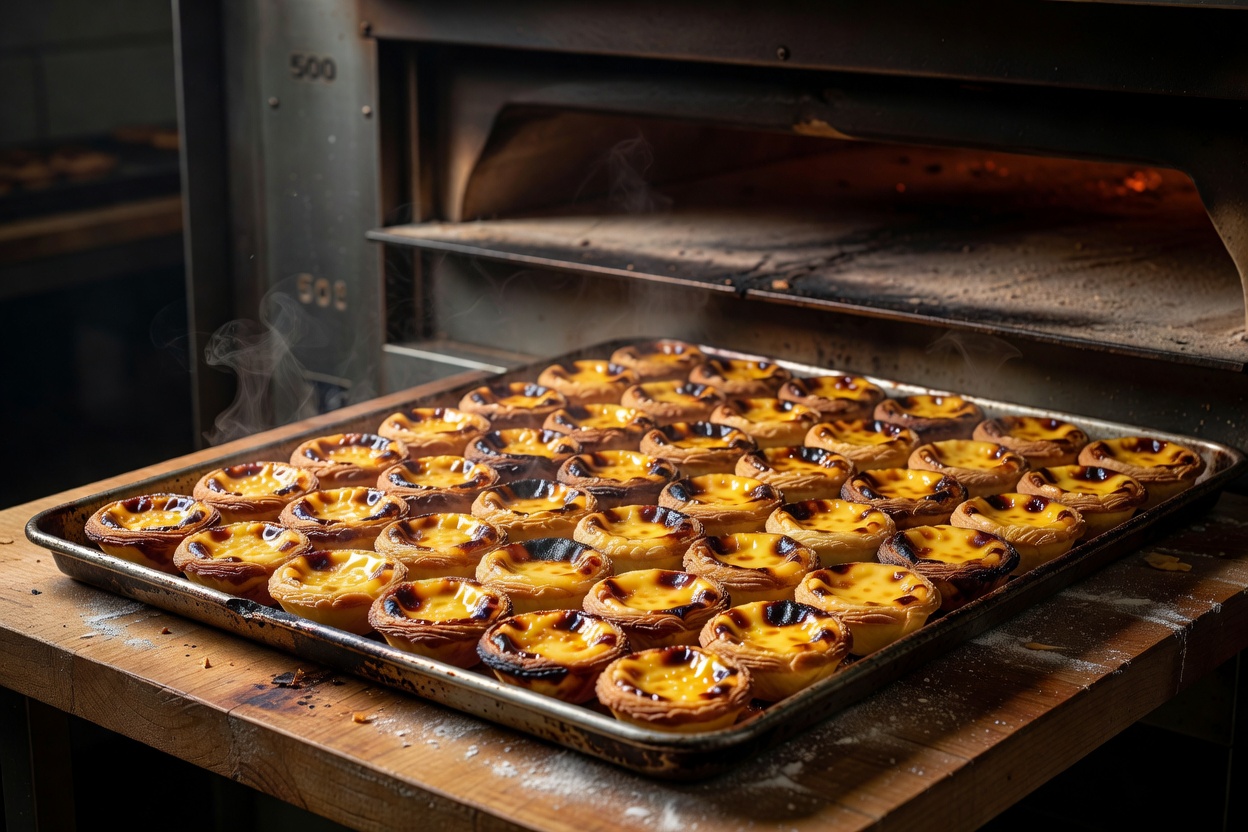
Tins are filled to three millimetres below the rim and go into a stone deck oven at 290°C for eleven to thirteen minutes. Domestic ovens rarely reach that temperature, which is why home natas tend to come out pale and the pastry underbaked. The heat has to hit the shell hard enough to set it before the custard has time to soak in.
We bake a tray every forty minutes from 06:00 until 17:00. A tray holds 100 tarts. On a Saturday we bake twenty-two trays; on a wet Tuesday in February, about twelve.
Prices
| Item | Price | Per tart |
|---|---|---|
| Single pastel de nata | €1.30 | €1.30 |
| Nata and bica combo | €2.60 | — |
| Box of 6 | €7.20 | €1.20 |
| Box of 12 | €13.90 | €1.16 |
| Tray of 50 (order 24 hours ahead) | €55.00 | €1.10 |
Cinnamon and icing sugar are free at the counter. We do not charge more to sit at a table, which is not universal in Lisbon — check the menu board in older cafés for separate balcão and mesa prices.
Warm or at room temperature?
Straight from the tray, the custard is almost liquid and the pastry is at its crispest; this is how most Lisboetas eat them. After thirty minutes the custard firms up, the flavours settle, and the tart is easier to eat one-handed on the tram. Both are legitimate. What you should avoid is a tart that has been sitting under a lamp for two hours, because by then the pastry has softened and the custard skin has gone leathery.
How to judge one
- Pick it up. The shell should feel dry and light, not greasy, and should hold its shape.
- Look at the base. Visible spiral layers mean it was hand-pressed from coiled dough rather than stamped from a sheet.
- The top should have dark caramel spots against a pale gold custard, never a uniform brown.
- Bite. Shatter first, then cool custard with a faint lemon note. If you taste mostly cinnamon, they are covering for something.
- The tin marks on the shell should be clean. Stuck, torn edges suggest leaking custard and underbaked pastry.