Where all the egg yolks came from
Most Portuguese sweets are doçaria conventual — convent confectionery. Nuns and monks used egg whites to starch linen and clarify wine, and were left with yolks by the bucket. Sugar arrived cheaply from Madeira and Brazil in the sixteenth century. The result was an entire family of desserts based on sweetened yolk: ovos moles from Aveiro, pudim Abade de Priscos from Braga, toucinho do céu from Guimarães. Even when a pastry is not yolk-based, it usually carries that convent DNA of almond, cinnamon and a heavy hand with sugar.
Our bench follows that tradition, adjusted for a modern café: slightly less sugar than the historical recipes, butter where lard would once have been used, and everything baked fresh in a single morning run between 05:30 and 09:00.
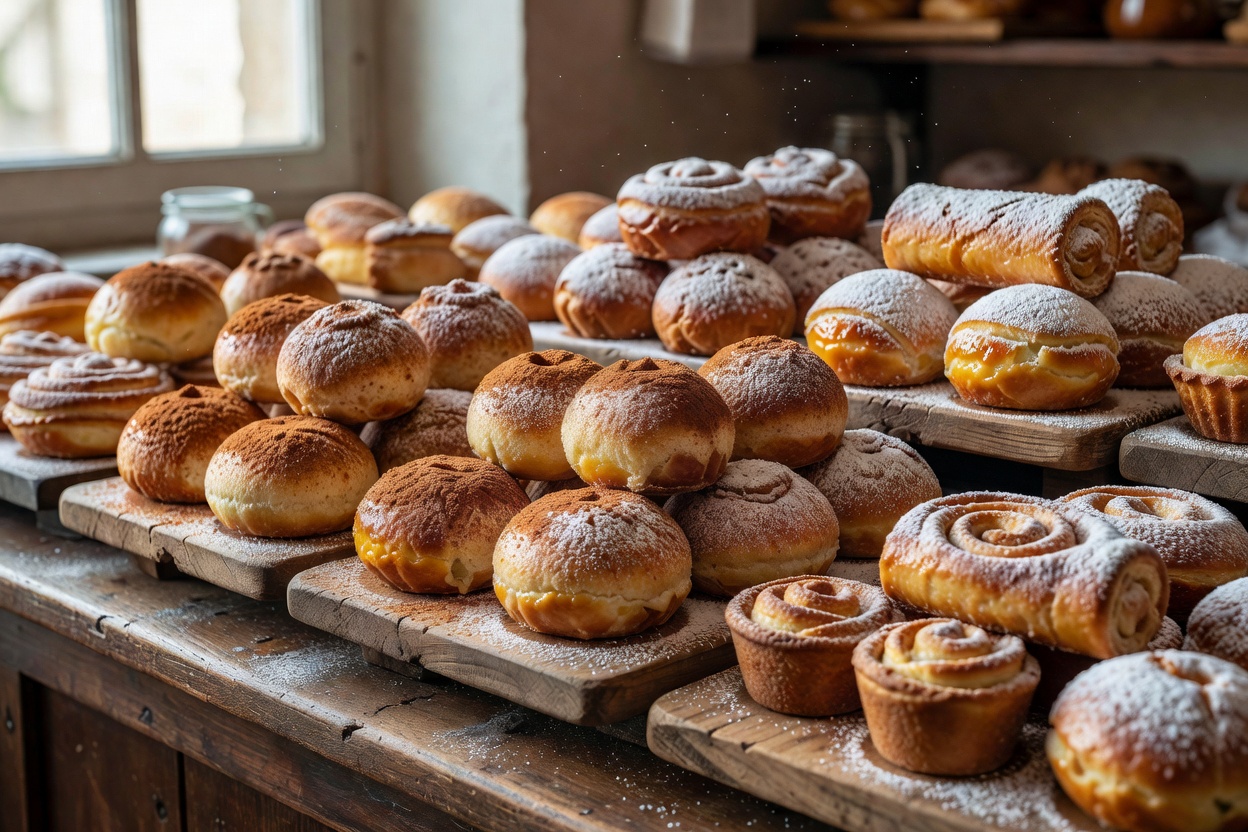
The morning cakes
Bolo de arroz
A rice-flour muffin wrapped in a paper collar, with a sugary crust and a soft, slightly grainy crumb that tastes faintly of lemon. It is the most everyday cake in Portugal and the one locals order most with their morning coffee. Not too sweet, keeps well, travels in a bag without falling apart. €1.40.
Pão de deus
"Bread of God": a soft, enriched bun topped with a moist crown of shredded coconut, sugar and egg. Halfway between brioche and a macaroon. Sold plain or split and filled with ham and cheese, which sounds wrong and tastes right. €1.60 plain, €3.90 with fiambre e queijo.
Queque
A plain butter cupcake with a domed, cracked top. Nothing clever, and often the thing you want at eight in the morning. €1.20.
The Sintra pair
Travesseiro
The "pillow": a rectangle of puff pastry filled with almond and egg cream, rolled in sugar and served warm. Made famous by the Piriquita bakery in Sintra since the 1940s. Ours is laminated with the same butter dough as our natas and filled to order at the counter so the sugar does not go damp. Rich, so one is enough. €2.30.
Queijada de Sintra
A small tart of fresh cheese, egg, sugar and cinnamon in a very thin, crisp, almost cracker-like shell. Recipes go back to the thirteenth century. Dense and chewy with a tangy edge. Sold in sixes traditionally; we sell singles. €1.20, or six for €6.50.
Beans, almonds and layers
Pastel de feijão
From Torres Vedras: a puff pastry cup filled with a paste of white beans, sugar, almond and yolk. The bean is undetectable as a bean and simply adds body. Sweet, dense, faintly marzipan-like. €1.60.
Jesuíta
A triangle of puff pastry layered with egg cream and glazed with a crackly meringue icing, originally from Santo Tirso in the north. Ours is the biggest pastry on the bench and the one that sells out first on weekends. €2.20.
The fried one
Bola de Berlim
Portugal's doughnut, brought by German-Jewish refugees in the 1930s and rapidly nationalised by filling it with egg-yolk cream instead of jam. A beach staple, sold from coolers up and down the coast in summer. We fry a small batch daily at 10:30 and they are best within an hour. €1.90.
Side by side
| Pastry | Origin | Texture | Sweetness | Price |
|---|---|---|---|---|
| Bolo de arroz | Nationwide | Soft, grainy crumb | 2 | €1.40 |
| Pão de deus | Lisbon | Pillowy bun, moist top | 3 | €1.60 |
| Queque | Nationwide | Dense butter cake | 2 | €1.20 |
| Travesseiro | Sintra | Flaky, creamy centre | 4 | €2.30 |
| Queijada | Sintra | Chewy, crisp shell | 3 | €1.20 |
| Pastel de feijão | Torres Vedras | Dense, marzipan-like | 4 | €1.60 |
| Jesuíta | Santo Tirso | Layered, crackly glaze | 5 | €2.20 |
| Bola de Berlim | Coast, via Berlin | Fried dough, thick cream | 4 | €1.90 |
Seasonal bakes
From mid-November until Kings' Day on 6 January we bake bolo-rei, the crown-shaped Christmas cake studded with candied fruit and nuts, and its fruit-free sibling bolo-rainha. A 900 gram bolo-rei is €18; order by 20 December for Christmas week. At Easter we bake folar, a sweet, aniseed-scented bread, €9 a loaf. In summer the bola de Berlim batch doubles and the travesseiro takes a holiday because the kitchen is too warm to laminate comfortably.
Buying a box or buying one
Mixed box of six (€9.50)
- Roughly ten percent cheaper than buying singles.
- Lets a table try everything without ordering eight coffees' worth of pastry.
- Travesseiro and bola de Berlim do not keep; eat those first.
Singles at the counter
- You get exactly what you want, warm, on a plate.
- Better for pastries best eaten within the hour.
- Costs slightly more per piece.